What is right?
The question "What is right?" asks whether an action or condition is able to coexist with everyone's freedom under a universal rule. In practice, this means that determining what is right requires identifying rules, laws, or policies that limit actions to within bounds to which everyone can agree. A rule that requires all vehicles to stop at a stop sign is a rule to which everyone is able to agree. The action of stopping is able to coexist with everyone's freedom under that rule. This side of the system, therefore, takes a proposed rule — for your family, your team, your organization — and checks it against every person or stakeholder it would actually bind to determine the extent to which adopting that rule would hinder them from achieving their ends. In this way, the system seeks to lay bare the extent to which a rule imposes on the members of a group so that each member can decide for themselves whether they are able to accept it.
The guided check — test a policy step by step
If you have a policy in mind and want to see what it would do, the guided check walks you through it in seven short steps. You describe your situation in a sentence or two, and Auturis suggests the groups it affects, which you can change. For each group, you say what they do and what for, and Auturis drafts a record of their reasons and activities. The record is marked as a draft, and you correct anything that is wrong. You then state the policy, Auturis puts it in the form of a rule, and you confirm the rule before it is tested.
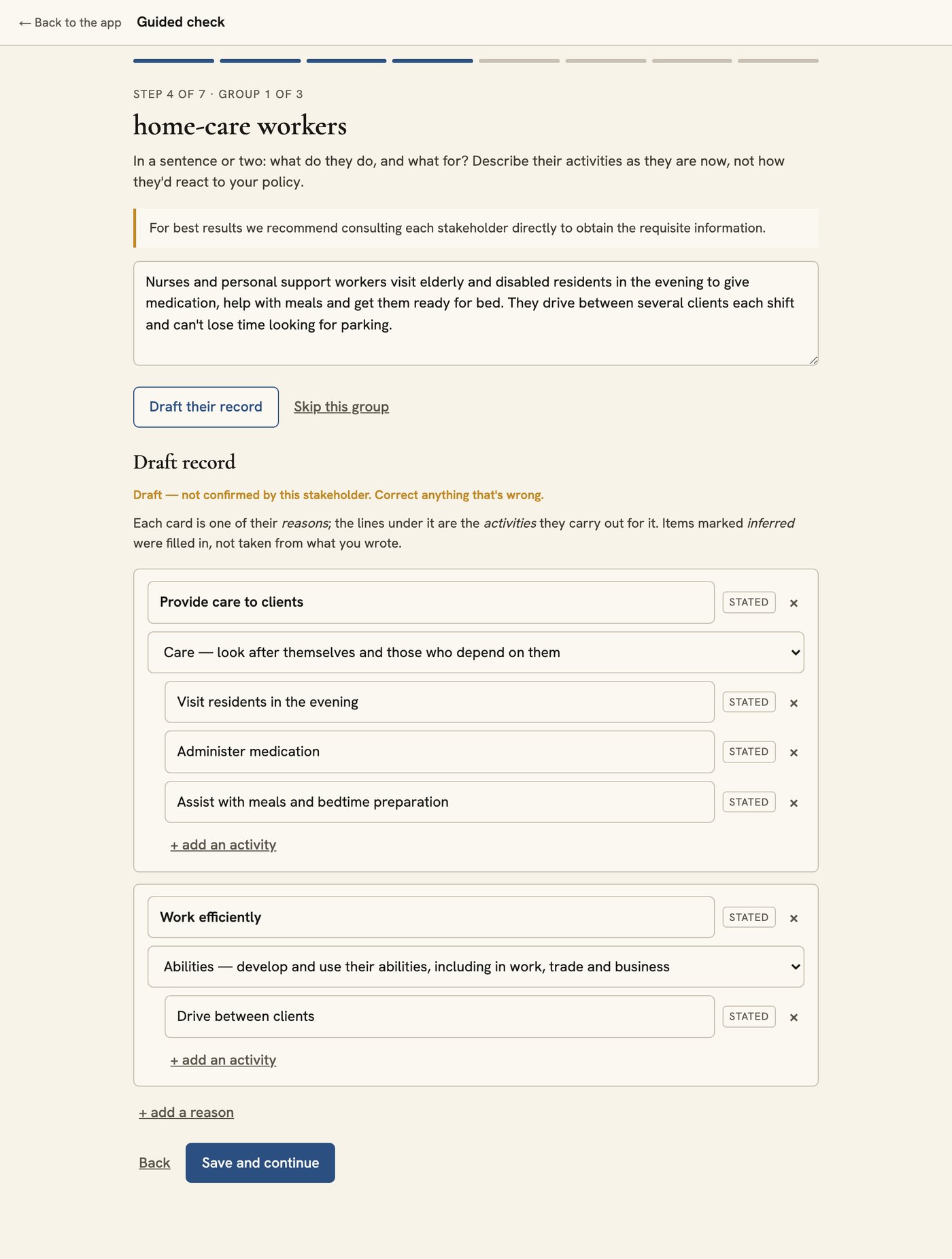
The result is a Stakeholder Hindrance Report: for each group, which of its recorded activities the rule would block and which it would restrict, and whether any group is left with no recorded activity open. Where the record does not settle whether the rule applies to a group, it asks you rather than guessing. It does not tell you whether to adopt the policy. That stays with you. You can download the report and give it, with the guide, to the AI assistant you already use for a plain-language analysis.

The check can only measure what has been recorded. Where you describe a group's activities yourself, it tests your account of them, not theirs; for anything that matters, consult each group directly. Three or four groups take about ten minutes.
Build — build the shared graph
Before any rule can be tested, the people it would bind need to be represented — each stakeholder brings their own commitments into the organization's shared graph. It's the same kind of conversation as the individual Build tab, just building toward a graph the whole group is party to, not just one person's.
Discern — refine your governance rule
Since it can sometimes be difficult to clearly formulate the rule that you would like to suggest for your group, we provide a structured discussion to help you identify it. Once the rule is isolated and you have confirmed it, we run the hindrance check described above.
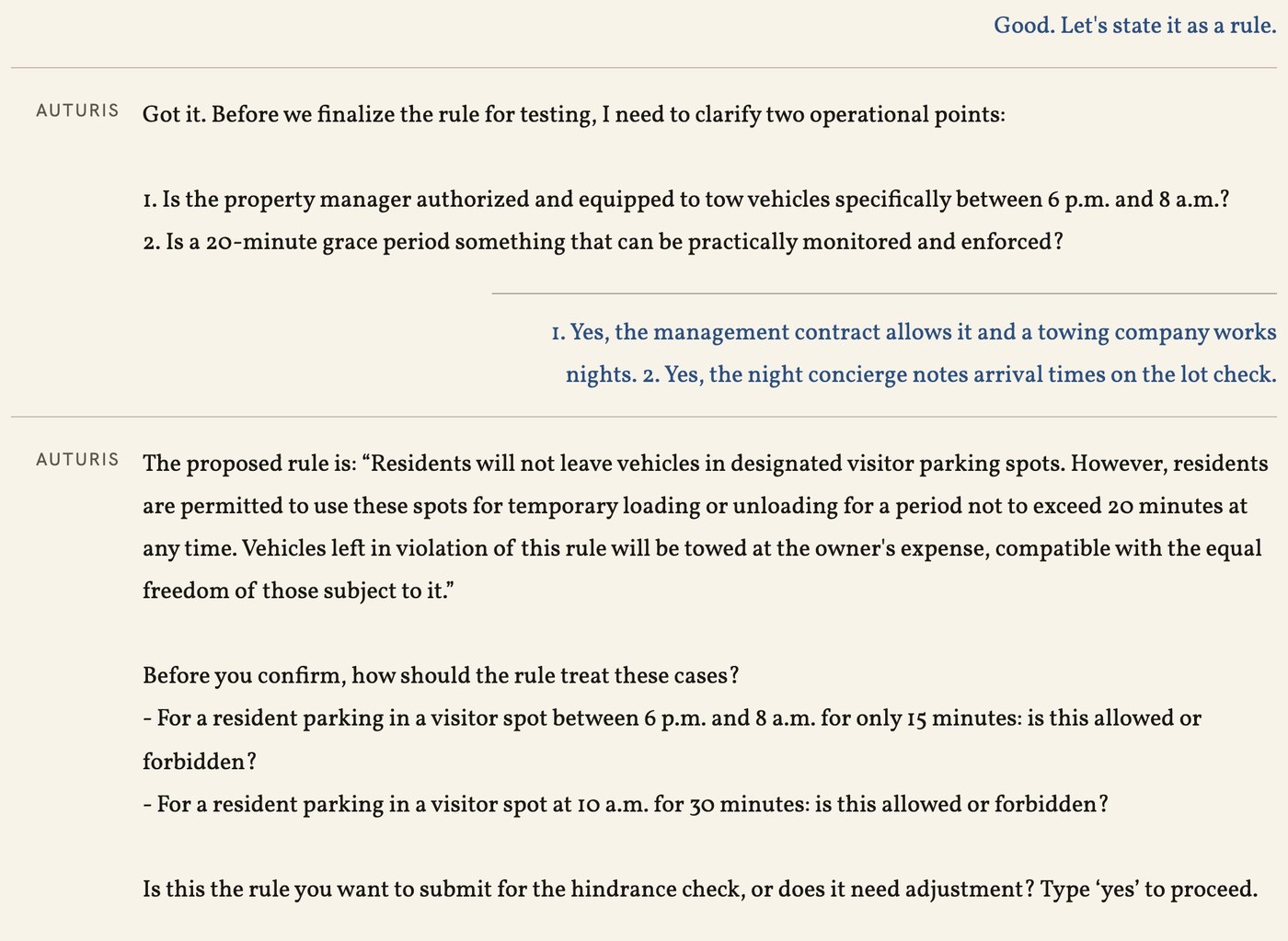
Four worked cases show it in practice, including a real historical case checked against what actually happened and a regulatory mapping to the EU AI Act and GDPR.
Submit a real case
Have a real governance rule or policy dispute in mind — yours, your organization's, or one you've read about, with more than one stakeholder and a genuine disagreement about what's fair? Send it in and I'll run it through the hindrance check myself and write back with the result and the reasoning behind it.
The result is only as trustworthy as what I have to build from, so please include, as best you can:
- The rule itself stated generally — who has the authority, what they'd do, under what conditions — not just an account of one specific incident.
- Every stakeholder the rule would actually affect, not only the two obvious sides.
- For each one, their real interest stated concretely — what's at stake and how, specifically. Vague summaries produce unreliable results.
- Roughly the same level of detail for every stakeholder you want compared against each other.
- For real situations: what's documented fact versus your own read of it.
A clean two-sided dispute, well described, is something I can stand behind. A case with several stakeholders needs multiple runs and a consistency check before I'd trust it, so I may ask follow-up questions rather than run something too thin — that's not gatekeeping, it's what keeps a verdict from being blamed on the system when it was really an underspecified case. No cost, no signup, and no promises on turnaround; I'm one person doing this by hand. If it turns out to be a good case, I'll ask before publishing it here alongside the four above — attributed or anonymized, your call.
Mediate — work through a disagreement together
Some conflicts aren't about a rule for the whole group — they're between two people, or two sides, who see the same situation differently and need to actually work it out. Mediate is built for that: each side brings their own graph of commitments into a shared session, and the system guides a real back-and-forth toward a resolution both sides can agree to. Once the two sides reach a resolution, it's checked with the same hindrance check used elsewhere in the system — whether it leaves either side with no way open, and what it hinders for each of them. So what they've agreed to isn't just something both people said yes to; both can see what it does to each of them before they sign.
Get access
Auturis is an early, closely-managed beta, available on request. How to get access.